
If you run an independent hotel, you have probably noticed that the people who do your marketing have started speaking in tongues. SEO was confusing enough. Now there’s AEO, GEO, AIO, LLMO, and roughly nine other three-letter combinations that all sound like they were generated by a cat walking across a keyboard.
Here’s the good news: under the acronym soup, there are really only three ideas. And once you understand the three, the whole landscape snaps into focus. This is the pillar post for our whole AI-visibility cluster, so we’re going to do it properly: define each one, show how they differ, show how they reinforce each other, and tell you exactly what to do for each.
Grab a coffee. No fluff.
US searches / month · source: DataForSEO
Google search
Branded + non-branded queries, the map pack, and Hotel Ads.
AI assistants
ChatGPT, Gemini & Perplexity recommending where to stay.
OTAs & metasearch
Booking.com, Expedia, Tripadvisor — the intermediaries.
Win all three and you depend less on any single one
The 30-second version
- SEO (Search Engine Optimization) = getting your hotel to show up in the classic list of links on Google.
- AEO (Answer Engine Optimization) = getting your hotel surfaced when the engine answers the question directly instead of handing over a list of links.
- GEO (Generative Engine Optimization) = getting your hotel named and recommended inside AI-written answers from ChatGPT, Gemini, Perplexity, and Google’s AI Overviews.
That’s it. Three jobs, one machine. The reason they all matter now is that the thing in the middle — how people actually find a place to sleep — has quietly changed underneath everyone’s feet.
Why the ground moved
For twenty years, “search” meant one behavior: type a thing, get ten blue links, click one. Hotels optimized for that, OTAs got terrifyingly good at it, and everybody learned the game.
That single behavior has now split into three.
- Classic search is still here and still huge. Someone types “boutique hotel savannah historic district,” scans the links and the map pack, and clicks. This is SEO territory, and it is not dying — people with their credit card out still search this way.
- Answer-style search is when Google (or Siri, or Alexa) just tells you the answer. “What time is check-in at The Marlowe?” doesn’t need ten links. The engine wants to read back one sentence. That’s AEO.
- Conversational / generative search is the new monster. A traveler opens ChatGPT and types, “I’m taking my wife to Asheville for our anniversary, we like quiet places with a good bar and no chain-hotel vibe, where should we stay?” The AI writes a paragraph naming three or four specific hotels. If you’re one of them, jackpot. If you’re not, you don’t exist in that conversation. That’s GEO.
The same human, asking about the same trip, now has three completely different front doors. If you only optimized for door number one, you’re invisible at the other two — and the other two are where the growth is.
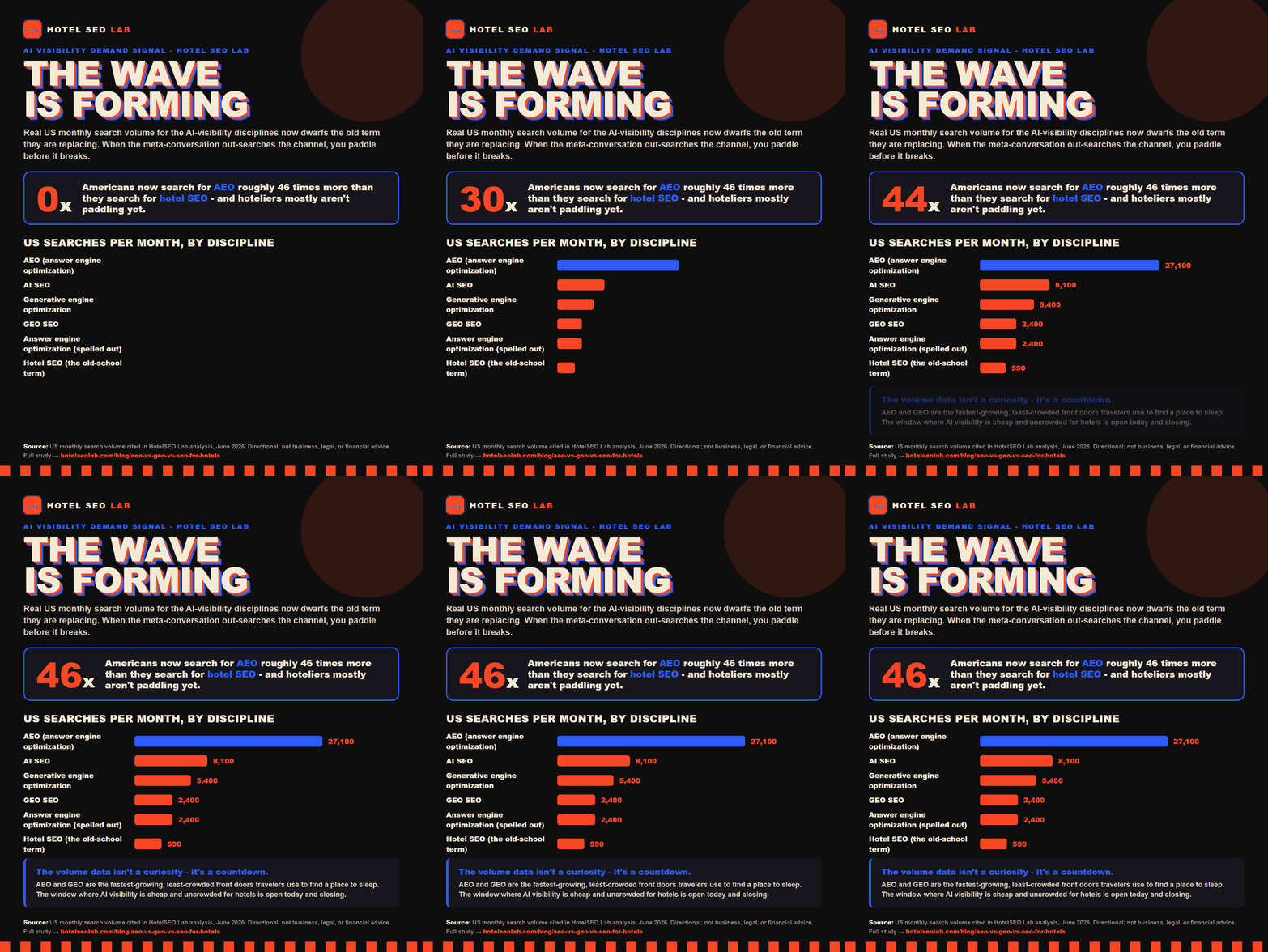
The demand signal is not subtle. Pulling real US monthly search volume, here is how much people are now searching for the disciplines themselves: AEO (answer engine optimization) sits at 27,100 searches a month. AI SEO is at 8,100. Generative engine optimization is 5,400, with GEO SEO at 2,400 and answer engine optimization (spelled out) another 2,400. For contrast, the old-school term hotel SEO pulls roughly 590. When the meta-conversation about a marketing channel is out-searching the channel it’s replacing, that’s the wave forming. You want to be paddling before it breaks, not after.
Download this study as a one-page PDF
SEO, properly defined (the base layer)
Search Engine Optimization is the practice of making your website easy for a search engine to find, understand, and rank, so that when someone searches a relevant query, your pages appear high in the results.
For a hotel, the bread and butter looks like:
- Ranking for “[your town] boutique hotel”, “hotels near [the big local thing]”, “pet friendly hotel [area]”, and your own brand name.
- Winning the local map pack (that trio of map listings) via a sharp Google Business Profile.
- Having fast, mobile-friendly pages with real content about your rooms, your location, and the stuff people actually ask about.
SEO is the base layer for a simple reason: the same things that make Google rank you also make you eligible for the answer box and quotable by the AI. Clean site structure, descriptive page content, and a credible brand presence are the raw material all three disciplines feed on. Skip SEO and you’ve built AEO and GEO on sand.
If your SEO house isn’t in order, start there. Our hotel SEO service page walks through what “in order” means for a property, and the table at the end of this post tells you the priority order.
AEO, properly defined (the answer layer)
Answer Engine Optimization is the practice of structuring your content so a search engine or voice assistant can lift a clean, correct answer straight out of your site and read it back to the user — often without them clicking anything.
The classic AEO surfaces:
- Featured snippets (“People also ask,” that boxed answer at the top).
- Voice answers from Siri, Alexa, and Google Assistant.
- Knowledge-panel facts — your hours, address, amenities, the stuff in the box on the right.
Here’s the mindset shift. SEO asks, “How do I rank this page?” AEO asks, “If a robot had to answer this exact question in one or two sentences, would my hotel’s site be the source it pulls from — and would it get the answer right?”
For a hotel, the highest-value AEO questions are boringly practical, and that’s the point:
- “What time is check-in / check-out at [hotel]?”
- “Does [hotel] have parking / a pool / free breakfast / pet rooms?”
- “How far is [hotel] from the airport / the convention center / the beach?”
- “Is [hotel] adults-only?”
These have one correct answer. Your job is to publish that answer in plain, structured language so the engine grabs your version instead of guessing or — worse — pulling it from a third-party listing that has it wrong. The mechanics live in markup and clean FAQ-style content; we go deep on the markup side in structured data to make your hotel quotable to AI.
The trap nobody warns you about: when an answer engine can’t find a clean, authoritative answer on your site, it doesn’t go silent. It confidently makes one up from whatever scraps it can find — a stale OTA listing, an old review, a competitor’s blog. AEO isn’t only about winning visibility. It’s about controlling the facts so the robot doesn’t lie about your hotel.
GEO, properly defined (the recommendation layer)
Generative Engine Optimization is the practice of getting your hotel mentioned, described accurately, and recommended inside the answers that generative AI tools write — ChatGPT, Gemini, Perplexity, Copilot, and Google’s AI Overviews.
This is the newest of the three and the most different in spirit. With SEO and AEO, the user still sees a list or a snippet and makes their own call. With GEO, the AI has effectively pre-shopped for them. It reads a paragraph: “For a quiet, design-forward anniversary trip in Asheville, consider…” and then names hotels. The traveler’s shortlist is built before they’ve visited a single website.
So the GEO question is: when a traveler describes the trip you’re perfect for, does the AI know to name you?
That depends on three things working together — what we call the trifecta, and it’s worth understanding because it’s the whole ballgame:
- Entity clarity. Does the AI understand what your hotel is — an adults-only boutique inn, 22 rooms, walkable to downtown Asheville, known for the bar? If your brand is a fuzzy blob on the web, you won’t get matched to specific trip descriptions.
- Citations and corroboration. AI models lean on what multiple credible sources say about you — travel press, local guides, “best of” roundups, consistent business listings. One mention is noise; agreement across sources is a signal.
- Quotable, structured content on your own site. The same clean, factual, well-marked-up content that powers AEO also gives the generative model something solid to ground its answer in.
We unpack all three in the GEO trifecta: schema, entity, citations, and if you want to see what travelers are actually typing into these tools, how travelers use AI to pick hotels is the field guide.
Here’s the honest framing on the payoff, because we don’t do hype. Getting named in AI answers will not let you escape the OTAs — no independent hotel can do that, and anyone promising it is selling you something. What it does do is shape the shortlist earlier, in a place the OTAs don’t yet dominate. When an assistant recommends you by name and the traveler comes to you to look you up, you’ve got a real shot at a direct booking instead of one that hands a commission to Booking.com. Do that consistently and you reduce OTA dependence, claw back some margin, and end up with a healthier booking mix. That’s the realistic prize, and it’s a good one.
How they actually differ (the cheat sheet)
| SEO | AEO | GEO | |
|---|---|---|---|
| What it wins | Ranking in the list of links | A direct answer / snippet | A mention inside an AI-written recommendation |
| Where it shows up | Google results, map pack | Featured snippets, voice, knowledge panel | ChatGPT, Gemini, Perplexity, AI Overviews |
| The user’s job | Pick a link and click | Read the answer (often no click) | Read the AI’s shortlist |
| Your core question | ”How do I rank this page?" | "Can a robot read back the right answer?" | "Will the AI name me for the right trip?” |
| Hotel example | Rank for “boutique hotel Savannah” | Win “what time is check-in at [hotel]?” | Get named for “quiet romantic hotel in Savannah” |
| Crowding | Brutal (OTAs dominate) | Moderate | Wide open, for now |
How they reinforce each other (this is the important part)
If you take one thing from this post, take this: these are not three separate budgets. They’re three outputs of the same underlying work. The overlap is enormous, and that’s wonderful news for an owner-operated hotel with finite time.
- A clean, fast, well-structured website (SEO) gives the answer engine clean text to lift (AEO) and gives the generative model trustworthy ground truth to quote (GEO).
- Sharp FAQ content and schema markup (AEO) directly feeds the “quotable content” leg of GEO.
- A clear, consistent brand entity across the web — same name, same description, same facts everywhere (GEO) — also strengthens your SEO and reduces wrong answers in AEO.
- Getting cited by travel press and local guides (GEO) builds the authority that lifts your SEO rankings too.
It compounds. Do the foundational work once and you become eligible across all three doors at the same time. This is exactly why we bundle SEO and AI visibility rather than selling them as rival line items — see AI visibility (AEO + GEO) for how that fits together.
What to actually do for each (practical, no filler)
For SEO (the base — do this first)
- Lock down your Google Business Profile. Correct category, accurate hours, real photos, every amenity ticked. This is the single highest-leverage hour in local hotel marketing.
- Build a real page for each thing you rank for — your location, your room types, “things to do nearby,” your meeting/event space. One thin homepage is not a strategy.
- Get the technical basics right. Fast load, mobile-friendly, clean URLs, no broken pages. Boring, non-negotiable.
- Earn local relevance. Get listed in the legit local guides and tourism sites for your area.
For AEO (the answer layer)
- Write an honest, thorough FAQ covering check-in, parking, pets, pool, breakfast, distances, accessibility — every practical question you get at the front desk. Answer each in one or two clean sentences.
- Add structured data (schema) so engines can read your facts unambiguously. Start with structured data to make your hotel quotable.
- Audit your facts everywhere. Make sure your check-in time and amenities match across your site, Google, and the OTAs. Conflicting facts are how robots end up wrong about you.
- Aim to be cited in Google’s AI Overviews — a specific, winnable target we cover in get your hotel cited in Google AI Overviews.
For GEO (the recommendation layer)
- Define your entity in plain language. On your own site, state clearly what kind of hotel you are, who you’re for, and what you’re known for. Don’t make the AI guess.
- Go earn corroborating mentions. Pitch local “best of” lists, travel writers, and niche guides. Agreement across sources is what convinces a model to recommend you.
- Consider an
llms.txtfile to give AI crawlers a clean map of your key facts — see llms.txt for hotels. - Audit what the AI already says about you. Go ask ChatGPT about your own hotel and your competitors. You’ll learn a lot, fast. Our walkthrough: audit what ChatGPT says about your hotel. If the answer is “nothing” or “wrong,” start with is your hotel invisible to ChatGPT.
So which one should you do?
All of them — but in order, and not as three separate projects.
Think of it as one stack. SEO is the foundation: get the website, the Google Business Profile, and the facts right. AEO is the next floor up: structure those facts so they can be read back cleanly. GEO is the penthouse: shape how the AI describes and recommends you. Because each floor reuses the one below it, the marginal cost of climbing higher is small once the foundation is solid.
For most independent hotels we work with, the right move is to keep the SEO base strong while moving aggressively on AEO and GEO now — because that’s where the demand is growing and where your competitors mostly aren’t yet. The volume data above isn’t a curiosity; it’s a countdown. The window where AI visibility is cheap and uncrowded for hotels is open today and closing.
None of this lets you fire the OTAs — keep that expectation realistic. What it does is win back more direct bookings, claw back margin one commission at a time, and leave you depending less on channels that charge you 15–25% for the privilege. A healthier mix, not a fantasy.
Where to start
If your head is spinning, don’t overthink it. Go open ChatGPT right now and ask it to recommend a hotel like yours in your city. Whatever comes back — your name, a competitor’s name, or nothing at all — that single test tells you which floor of the stack to start on.
When you’re ready for a real plan, book a free intro call and we’ll show you exactly where your hotel stands across SEO, AEO, and GEO — and which moves will move the needle fastest. Or dig into our AI visibility service to see how the whole stack comes together. No tongues, we promise.