
So you want a plan. Not a vibes-based “post more on Instagram and pray” plan, but an actual week-by-week thing you can print, tape to the wall behind the front desk, and tick off between check-ins.
Good. Here it is. Ninety days, five workstreams, starting this week. No magic, no growth-hacking nonsense, just the unglamorous work that gets an independent hotel found in Google and in AI search, then nudges those visitors toward booking on your own site instead of paying a 15 to 25 percent toll to an OTA every single time.
Quick honesty check before we start: this plan will help you reduce OTA dependence and win back more direct bookings. It will not let you fire the OTAs and ride off into the sunset. Nobody can promise that, and anyone who does is selling you something. The OTAs are a billboard you rent. The point is to stop renting all of your bookings and start owning a healthier slice. Cool? Cool.
Google search
Branded + non-branded queries, the map pack, and Hotel Ads.
AI assistants
ChatGPT, Gemini & Perplexity recommending where to stay.
OTAs & metasearch
Booking.com, Expedia, Tripadvisor — the intermediaries.
Win all three and you depend less on any single one
How this plan is structured
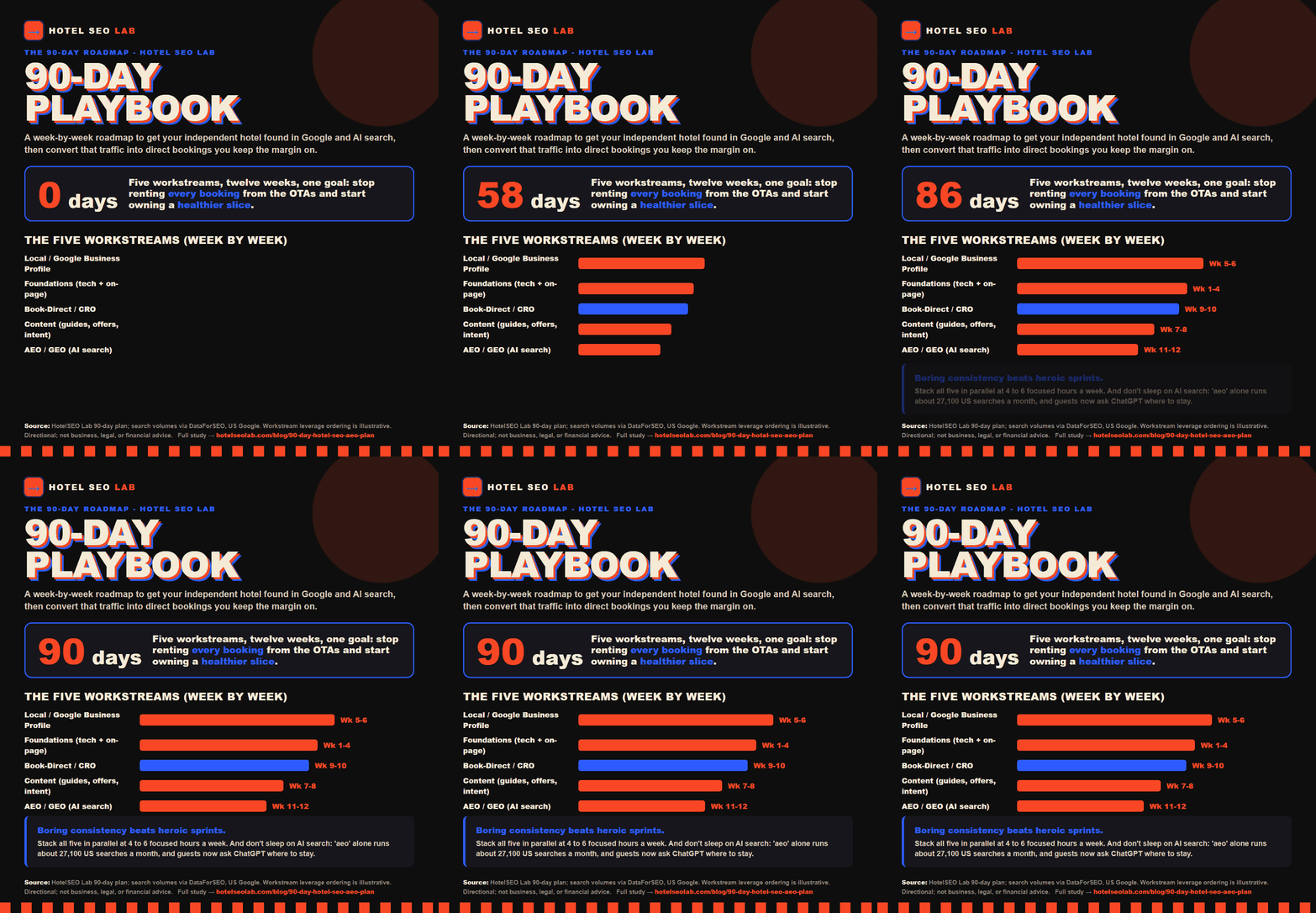
Five workstreams run in parallel across the quarter:
- Foundations - the technical and on-page plumbing.
- Local - Google Business Profile, maps, citations.
- Content - the pages and posts that actually pull traffic.
- Book-Direct - turning that traffic into reservations you keep the margin on.
- AEO/GEO - getting cited by ChatGPT, Google AI answers, and the rest.
Each month has a theme, but the workstreams overlap on purpose. You are not finishing one before starting the next. You are stacking.
Budget roughly 4 to 6 focused hours a week. Less than that and you are not running the plan, you are admiring it. Block the time on a recurring calendar invite called something boring like Ops so nobody steals it.
Download this study as a one-page PDF
Month 1: Fix the foundation (weeks 1-4)
This is the month where you resist the urge to write blog posts and instead make sure Google and the AI crawlers can actually read your site. Pretty content on a broken foundation is lipstick on a 404.
Week 1 - Audit and access
You cannot fix what you cannot see. This week is pure setup.
- Claim your tools. Google Search Console and Bing Webmaster Tools, both verified. Bing matters more than it used to because it quietly feeds a chunk of AI search.
- Confirm analytics actually works. Open your own booking engine, make a test booking to the payment step, and watch whether the events fire. You would be amazed how many hotels have “tracking” that tracks nothing.
- Crawl your own site. Run a crawler (or have us do it) to surface broken links, redirect chains, missing titles, and orphan pages. Write down the top 10 problems.
- Inventory your money pages. Homepage, rooms, rates/offers, location, the booking engine entry. These five get priority on everything that follows.
Week 2 - Technical cleanup
- Fix the broken stuff from your crawl: 404s, redirect chains, duplicate pages competing with each other.
- Page speed. Hotel sites are notorious for 4MB hero images and a slideshow nobody asked for. Compress images, lazy-load below the fold, kill unused scripts. This is one of the few spots you may need your developer or web vendor.
- Mobile check. Most of your booking-intent traffic is on a phone in a parking lot or an airport. If the booking button is below three screens of scrolling, fix it.
Week 3 - On-page basics
- Title tags and meta descriptions on the five money pages. Put the city and the hotel type in the title. “Boutique Hotel in [Town] | [Hotel Name]” beats “Welcome” every day of the week.
- One clear H1 per page. Headings should describe the page, not be decorative.
- Internal links. Link rooms to offers, offers to location, location back to the booking page. Help Google and the AI crawlers understand which pages matter.
Week 4 - Schema and structured data
- Add Hotel and LodgingBusiness schema with your name, address, phone, price range, and star rating. Add FAQ schema to pages that answer real guest questions.
- This is the second spot you may want a developer, though many booking engines and CMSs can output schema with a plugin.
- Validate it. Broken schema is worse than none because it erodes trust signals.
By the end of Month 1 your house is clean. Now you furnish it.
Month 2: Local + content (weeks 5-8)
Week 5 - Google Business Profile deep clean
Your Business Profile is the single highest-leverage free asset you own, and most hotels treat it like a chore.
- Categories correct (primary plus relevant secondaries), hours accurate, every booking and contact link populated.
- Photos. Upload 20-plus real, high-quality images. Exterior, lobby, every room type, the breakfast, the view, the dog if you are pet-friendly. The dog photo earns more clicks than you would believe.
- Turn on messaging only if someone will actually answer it.
Week 6 - Citations and reviews engine
- NAP consistency. Your Name, Address, and Phone must be byte-for-byte identical across your site, Business Profile, TripAdvisor, and the big directories. Inconsistent NAP confuses both Google and AI assistants about which info is correct.
- Reviews. Build a simple system: a post-stay email or a QR code at checkout that asks happy guests to review you. Reply to every review, good or bad. AI assistants increasingly summarize review sentiment, so the words guests use about you literally become your description in AI answers.
Week 7 - Cornerstone content
Now you write, but strategically. Build pages around what guests actually search and ask:
- A genuinely useful area/neighborhood guide (“things to do near [Hotel]”). Be specific, name the taco place, link the trailhead.
- A rooms comparison page that helps people self-select instead of bouncing to an OTA to “see options.”
- An offers/packages page that gives direct bookers a reason to book direct.
Write like a sharp local friend, not a brochure. Specificity is what gets you cited later.
Week 8 - Content for intent + email kickoff
- Publish one or two bottom-funnel posts: “best time to visit [Town],” “where to stay in [neighborhood].” These catch people who are close to booking.
- Stand up your email program. If you are not emailing past guests, you are leaving the cheapest direct revenue on the table. Start with our guides on pre-arrival and post-stay email flows and midweek-filling email campaigns. Email is owned, free, and it does not charge commission.
The fastest path to direct revenue is not a stranger discovering you for the first time. It is a past guest who already loved the place getting one well-timed, genuinely useful email. Mine the list you already have before you spend a dollar chasing strangers.
Month 3: Book-direct + AEO/GEO (weeks 9-12)
Months 1 and 2 built the engine. Month 3 is where you point it at margin.
Week 9 - Conversion rate optimization
Traffic that does not convert is a vanity metric. Tighten the path to “book.”
| Fix | Why it matters |
|---|---|
| Sticky “Check availability” button | Removes friction on mobile, where most booking intent lives |
| Best-rate / book-direct message | Gives a concrete reason to skip the OTA tab |
| Fewer form fields | Every extra field quietly costs you completed bookings |
| Trust signals near the button | Free cancellation, real reviews, secure-checkout cues calm nerves |
| Fast, lightweight booking engine | Slow engines are where direct bookings go to die |
Our book-direct CRO service exists for exactly this, but you can move the needle yourself in a focused week.
Week 10 - Recapture the leakage
Most visitors leave without booking. That is normal. The goal is to bring the warm ones back without overpaying.
- Retargeting. Show ads to people who visited your rooms or rates pages and did not book. It is cheap relative to OTA commission. Start with our hotel retargeting playbook.
- Paid search, surgically. Bidding on your own brand name keeps OTAs from buying ads above your own listing and charging you commission on a guest who was literally searching for you. Read when an independent hotel should run Google Ads before you spend, so you spend on the right terms.
Week 11 - AEO/GEO foundations
Here is the shift most hotels are sleeping on. People do not only Google “hotels in [town]” anymore. They ask ChatGPT “where should I stay in [town] for a quiet anniversary weekend” and book whatever it recommends. If you are not in that answer, you do not exist for that guest.
The good news: AEO (answer engine optimization) and GEO (generative engine optimization) build on the SEO foundation you already laid. For context on how these differ, see AEO vs GEO vs SEO for hotels. This week:
- Answer real questions in plain language. AI assistants extract and cite clear, factual answers. The FAQ content and area guides you wrote in Month 2 are doing double duty now.
- Make your facts machine-readable. Consistent NAP, schema, clear room descriptions, real amenities listed as text and not buried in an image.
- Audit your AI visibility. Actually ask ChatGPT and Google’s AI answers about your town and see if you show up. Our guide is your hotel invisible to ChatGPT walks through the test.
For perspective on the search demand here: “aeo” runs about 27,100 US searches a month, “ai seo” about 8,100, and “generative engine optimization” about 5,400. This is not a fringe trend. It is where attention is moving.
Week 12 - GEO depth + measure everything
- Earn third-party mentions. AI assistants lean heavily on what other trusted sites say about you. A local-press feature, a “best boutique hotels in [region]” roundup, a travel blogger’s honest writeup, these become the source material AI cites. Pitch a few this week.
- Tighten review velocity. Steady, recent, specific reviews feed both local rankings and AI summaries.
- Report. Pull 90 days of data: organic traffic, Business Profile actions, direct-booking share, AI mentions. Decide what to repeat and what to drop. Then plan the next quarter, because SEO and AEO are a flywheel, not a finish line.
If you want a deeper architecture for the AI side, our AI visibility (AEO/GEO) service is built around exactly this, and how OTAs steal search explains why this work matters for your margin.
The honest caveat
Ninety days will not magically flip you from 80 percent OTA to 80 percent direct. Anyone promising that is lying or about to. What this plan reliably does is build the foundation, the local presence, the content base, the conversion path, and the AI visibility that let direct bookings compound, month after month, so your OTA mix gets healthier and you claw back margin you are currently handing over by default.
Boring consistency beats heroic sprints. Run the 90 days, then run them again with better content and tighter targeting.
Start this week
Pick week 1. Claim Search Console, run a crawl, make a test booking, and write down your top 10 problems. That is your Monday. Everything else stacks on top.
If you would rather hand the boring 90 days to people who do this for boutique hotels all day, check our pricing or book a call and we will build the version of this plan that fits your property, your market, and your margins.