
Let us start with the uncomfortable part. You searched your own hotel last week, did not you, and there was Booking.com sitting above your own website. Maybe Expedia too. Possibly a metasearch ad you are paying for to rank against yourself. That little stab of betrayal you felt? That is the entire reason this guide exists.
This is the pillar overview. The big map. If you run an independent or boutique property somewhere between 15 and 150 rooms, and “SEO” has always lived in the same mental folder as “things my web guy mumbles about,” this post is the one that untangles it. No jargon dumps, no 47-point checklists you will never finish. Just what hotel SEO actually is in 2026, what genuinely moves the needle, how long it really takes, and the order you should do things in.
Google search
Branded + non-branded queries, the map pack, and Hotel Ads.
AI assistants
ChatGPT, Gemini & Perplexity recommending where to stay.
OTAs & metasearch
Booking.com, Expedia, Tripadvisor — the intermediaries.
Win all three and you depend less on any single one
What hotel SEO actually is (and what it is not)
Hotel SEO is the practice of making your property easy for search engines, and now AI assistants, to find, understand, and recommend, so that more travelers land on your own booking engine instead of someone else’s.
That is it. The mission underneath all of it is margin. Every direct booking you win is a booking where you did not hand 15 to 25 percent to an online travel agency. The OTAs are not the enemy, by the way, they are a useful storefront and they will stay part of your mix. But right now most independents lean on them far harder than they need to, and SEO is how you tilt that balance back toward yourself.
Here is what hotel SEO is not:
- It is not a one-time project you finish. It is closer to housekeeping. You do it continuously or the room gets dusty.
- It is not paid ads. Those are metasearch and PPC, different beast, different budget line.
- It is not magic words you sprinkle on a page. Keyword stuffing died years ago and Google will quietly ignore you for trying.
- It is not a way to fully escape the OTAs. Anyone promising that is lying to your face. The honest goal is a healthier channel mix.
If your direct-booking percentage went up five points this year, you would feel that in your bank account more than almost any other marketing move you could make. SEO is one of the few channels where the asset you build keeps paying after you stop spending.
The five levers that actually move the needle
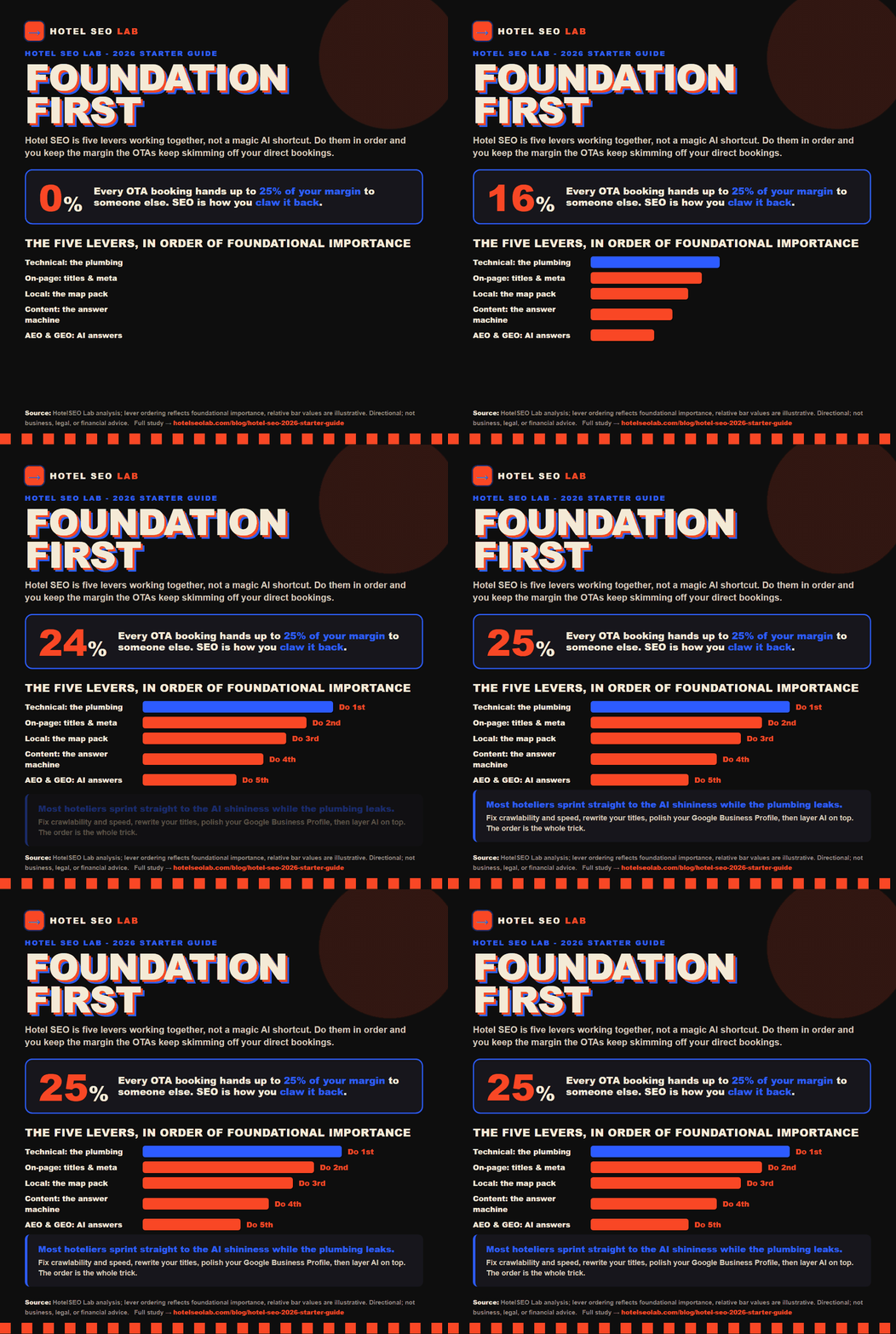
There are exactly five areas worth your attention. Get these right, in roughly this order of foundational importance, and you are ahead of most of your comp set.
1. Technical SEO: the plumbing
This is the boring, invisible stuff that determines whether Google can even read your site properly. If the plumbing is broken, nothing else you do matters, because the search engine never sees your beautiful rooms.
The big three for hotels:
- Site architecture. Can a search engine and a human both find your rooms, your rates, your location, and your booking path in two or three clicks? A surprising number of hotel sites bury the booking widget or hide room types behind a clunky carousel. We go deep on this in how to structure a hotel website that ranks.
- Page speed. Travelers bounce off slow sites, and a slow site quietly suppresses your rankings and your conversion at the same time. A hero video that takes six seconds to load is costing you bookings right now. Our breakdown on hotel page speed and direct bookings shows what to actually fix.
- Crawlability and indexing. Make sure your important pages are not accidentally blocked, that you have a clean sitemap, and that you are not generating thousands of junk URLs from filter combinations.
Quick gut check: open your homepage on your phone, on hotel wifi if you can, and count the seconds until you can tap the book button. If it is more than three, you have found your first project. Page speed is one of the few SEO fixes that improves rankings and conversion at the same time.
Download this study as a one-page PDF
2. On-page SEO: telling Google what each page is about
Once the plumbing works, every page needs to clearly signal what it is for. The two highest-leverage elements are the ones almost nobody touches: your title tags and meta descriptions. These are the blue headline and gray summary that show up in search results, and they are basically free advertising you control.
A title tag like “Home” or “Welcome” is a wasted asset. A title like “Boutique Hotel in Savannah Historic District | The Marlowe” tells Google and the traveler exactly what they are getting. We wrote a whole field guide on writing hotel title tags and meta descriptions because the wins here are fast and embarrassingly easy.
On-page also covers your headings, your room descriptions written for humans rather than copied from a brand manual, your image alt text, and structured data markup that tells search engines “this is a hotel, here is the price range, here are the reviews.”
3. Local SEO: the map pack is your lobby
For a hotel, local search is not a side dish, it is the main course. When someone searches “hotels near the convention center” or “boutique hotel downtown,” the map results at the top, the famous three-pack, drive enormous booking intent.
The non-negotiables:
- Claim and obsessively maintain your Google Business Profile. Correct category, correct address, real photos, accurate amenities, and the booking link pointed at your direct site.
- Reviews, and replies to reviews. Volume, recency, and your responses all feed local rankings. Reply to the cranky ones politely. Future guests read those.
- Consistent name, address, and phone number across every directory that mentions you. Inconsistency confuses the algorithm.
4. Content: the answer machine
Content SEO is where you stop fighting only for “[your city] hotel” and start capturing the hundreds of questions travelers ask around a trip. “Best time to visit Asheville,” “things to do near the river arts district,” “pet friendly hotels with parking downtown.” Each helpful page is a doorway, and each doorway is one more chance to be found before the OTA gets the click.
This is also the part of SEO most people skip, which is exactly why it works. Most independents have a stale blog with three posts from 2019. A genuinely useful local content layer is a moat your chain competitors rarely bother to dig.
5. AEO and GEO: showing up inside AI answers
Here is the genuinely new lever for 2026. A growing slice of travel research now happens inside AI assistants. Someone asks ChatGPT “where should I stay in Charleston for a quiet anniversary weekend,” and the model answers with specific recommendations. If your hotel is not in that answer, you are invisible to that traveler, and they never even reached a search results page where you might have ranked.
This discipline goes by a few names. AEO (answer engine optimization) gets a surprising amount of US search volume, around 27,100 a month. GEO (generative engine optimization) runs about 5,400, and the broader “AI SEO” term sits near 8,100. The names are still settling, but the work is real.
The reassuring news: AEO and GEO sit on top of good SEO, they do not replace it. Clean structured data, clear factual content, strong reviews, and being cited around the web all help models pick you. If you want the deeper dive, start with whether your hotel is invisible to ChatGPT and the breakdown of AEO versus GEO versus SEO for hotels.
Realistic timelines (so you can ignore the liars)
The single fastest way to spot a bad SEO vendor is a promise of page one in two weeks. SEO compounds. Here is what honest progress looks like for a typical independent hotel.
| Time frame | What to realistically expect |
|---|---|
| Weeks 1 to 4 | Technical fixes shipped, title tags rewritten, Google Business Profile cleaned up. Branded searches (your own name) start improving. |
| Months 2 to 3 | Local pack movement on some terms, faster site, first content pages indexed and picking up impressions. |
| Months 3 to 6 | Meaningful local ranking gains, growing direct-booking share, early AI citations if you have done the AEO groundwork. |
| Months 6 to 12 | Competitive non-branded terms begin to climb, content library starts compounding, the channel mix visibly shifts toward direct. |
Two honest caveats. First, these are illustrative ranges, not guarantees, your market, your starting point, and your competition all move the dial. Second, the very first win, ranking above the OTAs for your own hotel name, is often the quickest and the most satisfying. If you are losing that battle today, read why your hotel ranks below the OTAs for your own name first, because that is leakage you can often stop fast.
Why the OTAs out-rank you (and what to do about it)
Quick reality check, because it shapes your strategy. The OTAs out-rank independents for one boring reason: scale. They have enormous domain authority, thousands of pages, and budgets you cannot match. You are not going to out-muscle Booking.com on raw size, and you do not need to.
What you can do is win the searches where intent is highest and your home-field advantage is real: your own name, your specific neighborhood, your unique amenities, your local expertise, and the long tail of questions a giant aggregator answers generically. That is where independents quietly claw back margin. We unpack the mechanics in how the OTAs steal your search traffic. The point is not to “beat” them, it is to stop overpaying them for bookings that should have been yours.
Your starting roadmap
If you do nothing else, do these, in this order. This is the 80/20.
- Search your own hotel name and screenshot what you see. That is your baseline and your motivation.
- Fix the plumbing. Crawlability, mobile speed, and a clean booking path. See the website architecture and page speed guides.
- Rewrite your title tags and meta descriptions across your key pages. Fast, free, high leverage. Here is exactly how.
- Claim and polish your Google Business Profile, and start a habit of replying to every review.
- Publish three genuinely useful local pages answering questions your guests actually ask.
- Layer in AEO and GEO once the foundation is solid, starting with structured data and factual clarity.
Notice the order. The mistake we see most often is a hotelier sprinting straight to step five or six, chasing AI shininess, while the plumbing leaks and the OTAs still out-rank them for their own name. Foundation first. Always.
The honest bottom line
Hotel SEO in 2026 is not one thing, it is five levers working together: technical, on-page, local, content, and the newer AEO and GEO layer for AI search. None of it is magic, all of it compounds, and the whole point is a healthier channel mix where you keep more of your own margin instead of routing it through the OTAs.
You do not have to do it all this week. You have to start, in the right order, and keep going. The hotels that quietly win back direct bookings are not the ones with the biggest budgets, they are the ones who stopped procrastinating on the boring foundational work.
If you would rather hand the boring foundational work to people who do this all day for independent hotels, that is literally our thing. Take a look at our hotel SEO service, our AI visibility, AEO and GEO service, or just check pricing and book a call. We will tell you honestly where your fastest wins are, even the free ones.