
Let’s be honest about how most independent hotels approach “getting found online.” You built a website in 2019, somebody’s nephew set up a Facebook page, you claimed your Google listing once, and the rest of your demand quietly got outsourced to a couple of online travel agencies that take a 15 to 25 percent cut for the privilege of standing between you and your own guests.
That worked, kind of, for a while. It does not work in 2026.
The places a traveler can find a hotel have exploded. It is no longer just Google’s blue links. It is the map pack, the review carousel, the “things to do nearby” AI summary, and increasingly a chatbot that confidently recommends three boutique hotels in your city without ever showing a search result page at all. Each of those surfaces is a door. Right now, for most independents, half the doors are locked and the OTAs have keys to the rest.
This is the pillar checklist. It is long on purpose. Work through it section by section, fix what’s broken, and you will pull more of your demand back into channels you actually control. The goal is not to “beat” the OTAs (you cannot, and you shouldn’t try). The goal is a healthier mix, a thicker margin, and more guests who book direct because they found you first.
The seven surfaces you need to win
Before the granular stuff, here’s the mental model. Your visibility lives across seven surfaces. Most hoteliers obsess over one (their website) and ignore the other six.
| Surface | Who controls it | The 2026 risk |
|---|---|---|
| Organic search (your site) | You | Slow site, thin pages, no schema |
| Local and maps (Google Business Profile) | You, mostly | Stale hours, no posts, ignored Q&A |
| Content and topical authority | You | No content, so AI has nothing to cite |
| Reviews and reputation | Guests, you respond | Unanswered reviews, low recency |
| Distribution and OTAs | Shared | Rate parity leaks, no direct incentive |
| Book-direct and conversion | You | Clunky booking flow, no reason to book direct |
| AEO and GEO (AI answer engines) | Emerging | You are invisible to ChatGPT and friends |
Now let’s go room by room.
1. Organic search: make your own house findable
This is table stakes, and most independent sites quietly fail it.
- Page speed on mobile. Run your homepage and a room page through a free speed test. If your largest image takes four seconds to paint on a phone on hotel-lobby wifi, you are losing bookings before the guest sees a price. Compress images, lazy-load the gallery, and kill the autoplay video hero if it’s the bottleneck.
- One clear page per intent. You need distinct, indexable pages for: each room type, your location/neighborhood, amenities (pool, parking, pet policy), and any signature draw (rooftop bar, spa, wedding venue). One giant scrolling homepage that tries to do all of this ranks for none of it.
- Title tags and meta descriptions that name the thing. “Home | Welcome” is not a title tag. “Boutique Hotel in [Neighborhood], [City] - The [Name]” is. Write them like a human searching would.
- Structured data (schema). Add Hotel and LodgingBusiness schema with your address, price range, amenities, and star rating. This is the machine-readable version of your hotel, and it feeds both Google’s rich results and, increasingly, the AI engines.
- Internal links that actually connect. Your room pages should link to your amenities, your location page, and your direct booking page. Orphan pages with no internal links are pages Google barely trusts.
Quick gut check: open your site on your phone in airplane-mode-then-reconnect conditions (slow data). Time how long until you can tap a real “Book” button. If it is over five seconds, that single fix is worth more than a month of content.
Download this study as a one-page PDF
2. Local and maps: your Google Business Profile is a storefront, not a phone book entry
For a hotel, the Google Business Profile (GBP) is arguably more valuable than the website, and it is criminally under-maintained at most independents.
- Every field filled, accurately. Hours, address, phone, website, check-in/check-out times, amenities, payment types. Empty fields are missed matches.
- Categories. Primary category “Hotel,” then secondary categories that fit (boutique hotel, bed and breakfast, etc.). Wrong primary category is a silent killer.
- Photos, refreshed. Add new, real photos monthly. Rooms, food, the front desk, the view. Stale photo sets read as a stale business to both guests and Google.
- Google Posts. Use them like a free billboard: midweek offers, events, seasonal packages. Most competitors never post, so even modest activity stands out.
- Q&A. Seed it yourself. Ask and answer the real questions (parking, pets, early check-in, airport distance). If you leave it blank, a random stranger or an OTA-fed answer fills the vacuum.
- The booking link. Make sure the “Book” button on your profile points to your direct booking engine where possible, not only an OTA. This is one of the highest-leverage book-direct moves you can make and it is free.
3. Content and topical authority: give the robots something to cite
Here’s the part most hoteliers skip and then wonder why they’re invisible. Search engines and AI assistants recommend places they understand. If your only content is a homepage and a booking widget, you have given them almost nothing to work with.
You do not need a blog mill. You need a handful of genuinely useful pages that prove you are an authority on your place:
- A real neighborhood guide. “Where to eat, walk, and wander near [The Hotel].” Specific. Name the coffee shop two doors down. This is exactly the kind of content AI engines love to summarize and cite.
- Seasonal and event pages. If your town has a festival, a marathon, a leaf-peeping season, you should own the “where to stay for [event]” conversation.
- Practical FAQ content. Parking, pets, accessibility, transport from the airport. These answer real questions and feed AI answers directly.
The big shift for 2026: content is no longer only about ranking blue links. It is about being the source an AI quotes. If you’ve never thought about that, start with our explainer on AEO versus GEO versus SEO for hotels before you write another word.
4. Reviews and reputation: recency and replies beat raw star count
Most owners think reviews are a vanity metric. They are a ranking and conversion engine.
- Volume and recency. A 4.6 with reviews from this month beats a 4.8 whose last review was two years ago. Set up a simple post-stay ask so fresh reviews keep arriving. Our guide to pre-arrival and post-stay email flows covers exactly when and how to ask without being annoying.
- Reply to everything. Every review, good and bad, gets a human response. This signals an engaged business to Google and reassures the next reader far more than the star number.
- Spread, don’t hoard. You want a healthy presence on Google, plus the review sites that matter in your market. AI engines pull sentiment from across the web, not just one platform.
- Mine reviews for content. The phrases guests use to praise you are the exact phrases future guests search. “Quietest hotel in the old town,” “best breakfast in [City]” - that’s your keyword research, written by your customers, for free.
Stars get the click. The reply gets the trust. A thoughtful, specific response to a mediocre review converts the skeptical reader watching from the sidelines, which is most of them.
5. Distribution and OTAs: a healthier mix, not a holy war
Time for the honest talk. You are not going to eliminate the OTAs, and you should stop fantasizing about it. They have billion-dollar marketing budgets and they genuinely send you guests you’d never reach otherwise. The realistic, profitable goal is to reduce your dependence on them and claw back margin on the bookings you can win directly.
OTA commissions typically run 15 to 25 percent. Every booking you shift from OTA to direct keeps that margin in your pocket. Here’s how you tilt the mix:
- Rate parity discipline. Make sure you are never more expensive directly than on an OTA. Guests who find a better deal on Booking after seeing your site will book there and you’ll have paid the commission for a guest you nearly had for free.
- A direct-booking advantage. Give a reason to book direct: best-rate guarantee, a free upgrade when available, late checkout, a welcome drink, loyalty perks. It does not have to be a discount that guts your rate.
- Own the billboard effect. Many guests discover you on an OTA, then go to Google to book direct. If your site and GBP are weak, you lose that handoff. Strong direct presence converts OTA discovery into direct revenue.
- Understand how OTAs intercept you. They literally bid on your hotel’s name. We break the mechanics down in how OTAs steal your search traffic - read it, then decide where defensive paid search is worth it. Speaking of which, see when your independent hotel should run Google Ads for the “is this worth it for me” math.
6. Book-direct and conversion: stop the leaks at the finish line
You can be wildly visible and still lose, if the moment a guest tries to book direct is clunkier than the OTA’s slick one-tap checkout. Visibility without conversion is just expensive window shopping.
- Booking engine on every page. The path from “I’m interested” to “dates and book” should never be more than one tap. A booking widget that lives only on a hidden subpage is a leak.
- Mobile checkout that doesn’t fight the guest. Big tappable date pickers, no surprise fees at the final step, guest-friendly cancellation displayed clearly. Hidden fees at step four are why people bounce back to the OTA.
- Retargeting the near-misses. Most people who hit your site do not book on visit one. A simple retargeting setup keeps you in front of them. Here’s our walkthrough on retargeting hotel site visitors.
- Email is your highest-margin channel. Once a guest is on your list, you reach them for nearly nothing. Use it for midweek fills and shoulder-season pushes; see email marketing for hotels and midweek demand.
- Conversion is a discipline, not a one-time fix. This is the whole point of our book-direct CRO service: finding and sealing the leaks between visibility and confirmed, full-margin bookings.
The simplest book-direct test in existence: try to book your own hotel on your own phone, from “found you on Google” to “confirmation email,” timing every tap. If you sigh in frustration at any point, your guests are bouncing to the OTA at that exact step.
7. AEO and GEO: be the answer, not just a result
This is the surface almost no independent hotel has touched, which makes it the biggest opportunity in this entire checklist.
Travelers now ask AI assistants things like “find me a quiet boutique hotel near the old town with parking and good breakfast.” The assistant does not show ten blue links. It names two or three hotels. If you are not one of them, you do not exist in that conversation, and that conversation is growing fast.
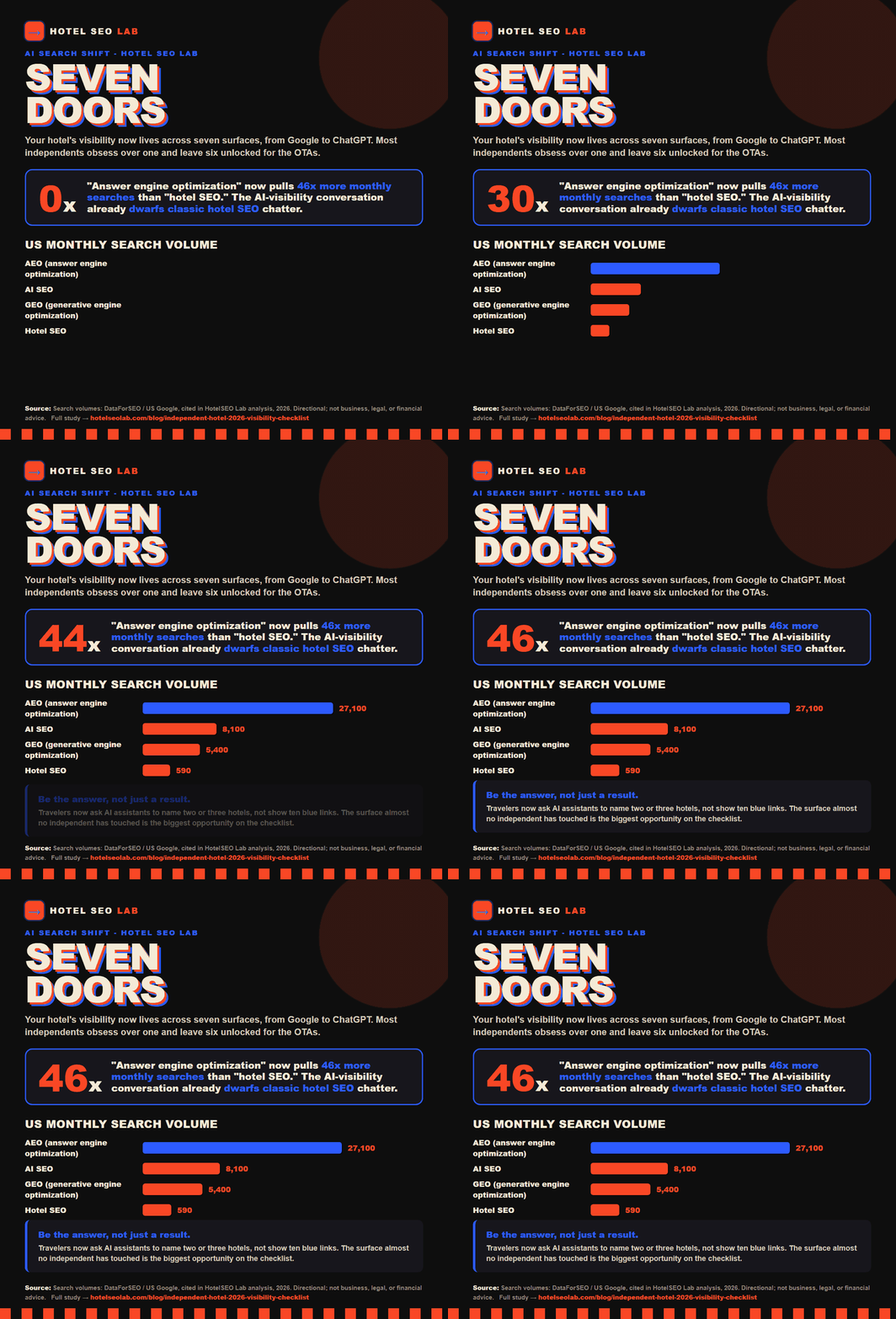
This discipline goes by a few names. The US search volumes tell you how seriously the industry is taking it: AEO (answer engine optimization) pulls around 27,100 searches a month, generative engine optimization (GEO) around 5,400, and AI SEO around 8,100. For context, hotel SEO sits around 590. The AI-visibility conversation is now an order of magnitude bigger than classic hotel SEO chatter.
What actually makes an AI engine recommend you:
- Clean, crawlable, structured content. AI reads your site the way a search engine does. Schema, clear headings, and plain-language facts (location, amenities, price range) are what get extracted and quoted.
- Consistent facts everywhere. Your name, address, amenities, and positioning should match across your site, GBP, and review sites. Contradictions make AI engines distrust and skip you.
- Citable, specific content. The neighborhood guide and FAQ pages from section three? That is the raw material AI summarizes. Vague marketing fluff gets ignored; specific, useful facts get cited.
- Third-party corroboration. AI cross-checks. Reviews, local listings, and mentions elsewhere reinforce that you are real, well-regarded, and a safe recommendation.
Want to know if you’re currently invisible to these tools? Start with is your hotel invisible to ChatGPT, then go deeper with our AI visibility, AEO and GEO service. This is the surface where moving now, before your competitors notice, is worth the most.
Your quarterly run-through, in order
Don’t try to boil the ocean. Work top to bottom, fix the cheap wins first:
- GBP audit (1 hour). Fill every field, post an offer, seed three Q&As, point the book button at your direct engine.
- Mobile booking test (15 minutes). Book your own hotel on your phone. Note every friction point.
- Speed check (30 minutes). Test homepage and a room page. Fix the heaviest image.
- Review pass (1 hour). Reply to every unanswered review. Turn on a post-stay ask.
- One content page (half a day). Write or refresh a genuinely specific neighborhood or FAQ page.
- Rate parity check (30 minutes). Confirm direct is never pricier than the OTAs.
- AI visibility check (30 minutes). Ask a few AI assistants to recommend a hotel like yours in your city. See if you appear.
Run that quarterly, spot-check monthly, and the compounding is real. Each surface you fix sends a little more demand into channels you own.
Where this leaves you
Visibility in 2026 is not one scoreboard, it is seven. The independents who win are not the ones with the biggest budgets. They are the ones who quietly locked every door the OTAs were sneaking through, gave the AI engines something true and specific to recommend, and made booking direct genuinely easier than the alternative.
You don’t have to do all seven perfectly. You have to stop ignoring six of them.
If you’d rather not run this gauntlet alone, that’s literally our job. Have a look at our pricing to see how we package SEO, book-direct CRO, and AI visibility together, then book a call and we’ll pressure-test your current setup against this exact checklist - and show you where the leaking margin is hiding.